
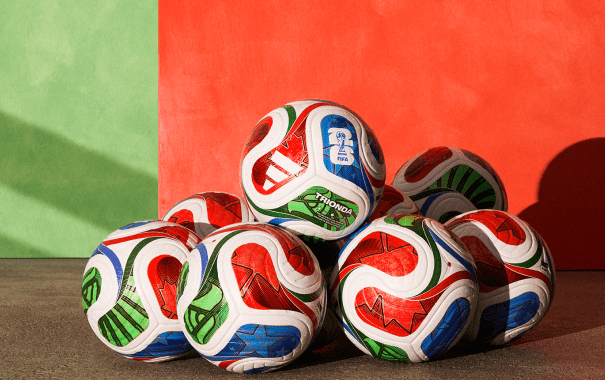
Billions of eyes will be on the players when the first match of the 2026 FIFA World Cup kicks off in Mexico City, but another star of the tournament will also be on the pitch, that is the TRIONDA.
Outdoored by Adidas as the official match ball for football’s biggest tournament in the world, TRIONDA will be kicked, headed and chased across stadiums in the United States, Canada and Mexico over the course of one month. However, unlike the balls used in previous generations, this one will not simply be part of the action.
It is not a mere football. Beneath its surface is a tiny motion sensor capable of tracking every touch and movement in real time, feeding data directly into the technology used by match officials. In many ways, TRIONDA represents how football’s most traditional competition has become one of its most technologically advanced.

The football story
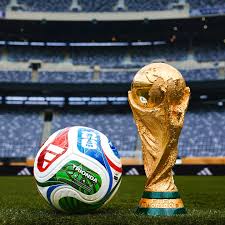
The black-and-white Telstar became an icon of the television age in 1970. The Tango design dominated football for nearly two decades. The Jabulani, used in South Africa in 2010, sparked controversy as goalkeepers complained about its unpredictable flight.
Now comes TRIONDA, a ball that FIFA and Adidas hope will become synonymous with a new era of football.
The name combines “tri” and “onda”, Spanish for “three waves” , a reference to the three countries hosting the tournament. It is the first men’s World Cup to be jointly hosted by three nations, and the ball’s design is intended to reflect that moment in football history.
Red, green and blue patterns wrap around its surface, representing Canada, Mexico and the United States. Look closely and there are further details: a maple leaf for Canada, an eagle for Mexico and a star for the United States. The coloured sections converge into a triangular shape, symbolising the union of the three hosts.
But it is what cannot be seen that makes TRIONDA remarkable.
According to FIFA, Inside the ball is a 500Hz motion sensor chip capable of sending data hundreds of times every second. The system allows officials to determine precisely when a player touches the ball and helps video assistant referees analyse incidents ranging from offside to handballs. FIFA says the technology will provide real-time information to support decision-making during matches.
In effect, the ball has become part of the officiating team.
That development reflects a broader shift in elite football, where technology increasingly influences everything from tactical analysis to refereeing decisions. Modern players wear performance trackers in training, stadiums are equipped with dozens of cameras, and algorithms now assist officials in interpreting some of the game’s most contentious moments.

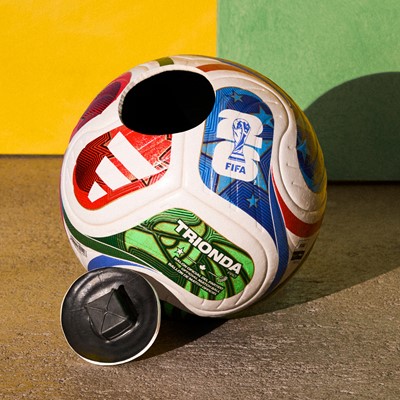
TRIONDA sits at the centre of that transformation.
Unlike traditional footballs made from numerous stitched panels, TRIONDA uses a four-panel construction with deep seams designed to improve stability as it travels through the air. The manufacturer says the design also enhances grip in wet conditions.
For players, however, technology alone will not define the ball’s legacy.
That will depend on what happens on the pitch. The ball becomes part of football’s collective memory.
Whether TRIONDA earns a place alongside those iconic predecessors remains to be seen. What is certain is that it will arrive at a World Cup unlike any before it, the largest in history, spanning three countries and featuring 48 teams for the first time.
By the time the final whistle blows next summer, TRIONDA may be remembered for spectacular goals, controversial decisions or, moments of heartbreak and glory, or perhaps for something else entirely.
For the first time, the World Cup ball will not merely witness history, it will help record it.
CREDIT:- africanews.com