

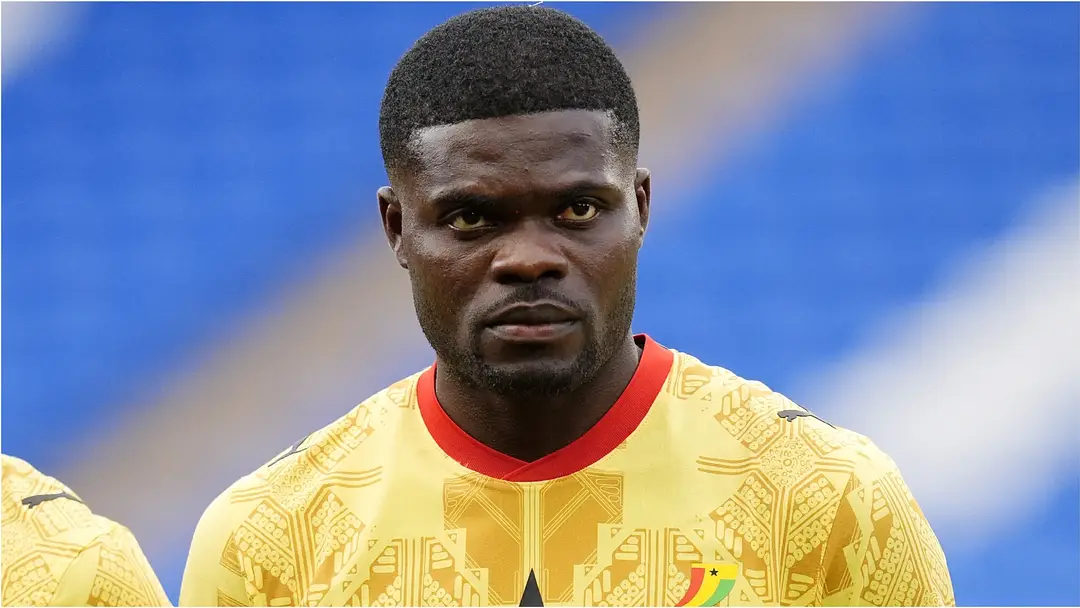
Ghanaian midfielder Thomas Teye Partey has been ruled out of Ghana’s opening 2026 FIFA World Cup match against Panama after Canadian authorities refused his visa application, preventing him from entering the country for the fixture in Toronto.
The Core Reason: Immigration “Inadmissibility”
According to multiple reports and FIFA confirmation, Canada denied Partey’s entry under its immigration laws, which allow authorities to refuse visas to individuals considered inadmissible on legal or security grounds.
In simple terms, even without a criminal conviction, a person can be denied entry if:
- They are currently facing serious criminal charges, or
- Authorities believe their case meets the threshold for inadmissibility under immigration law
The Legal Situation Behind the Decision
The key factor influencing the visa refusal is that Thomas Partey is currently facing multiple criminal charges in the United Kingdom, including allegations of rape and sexual assault.
- In July 2025, he was charged with five counts of rape and one count of sexual assault by London’s Metropolitan Police. He later pleaded not guilty in September 2025.
- In February 2026, he was charged with two additional counts of rape, to which he again pleaded not guilty in April.
The allegations involve multiple complainants and incidents said to have occurred between 2020 and 2022.
Although he has not been convicted, Canada’s immigration system can treat serious pending charges as grounds for denying entry. He is currently awaiting trial at Southwark Crown Court in London.


The Key Reason: Canada’s Immigration Rules on “Admissibility”
Canadian immigration law gives authorities the power to refuse entry to individuals considered inadmissible, including people who:
- Have been charged with serious criminal offences, or
- Are believed to present a potential security risk, even without a conviction
Canada’s official guidance states that individuals “may not be allowed into Canada” if they have committed or been convicted of certain crimes.
In Partey’s case, the visa refusal is linked to his ongoing legal situation.
Official Position from Canadian Authorities
Canada’s immigration department (IRCC) has previously stated that:
- Safety and security are the top priority
- Immigration decisions are applied consistently, regardless of status or nationality
- Officers may refuse entry if they believe an individual could pose a risk
They also emphasized that each case is assessed individually under Canadian immigration law.
Why a Visa Can Be Refused Without a Conviction
A key point in this case is that a criminal conviction is not required for visa refusal under Canadian law.
Immigration officers can deny entry if they believe:
- The applicant may be inadmissible under criminality or security grounds
- The seriousness of the charges meets the threshold for exclusion
- Allowing entry could conflict with public safety considerations
This explains why Partey’s application was rejected despite the case still being pending in court.
What is FIFA’s position in this Matter
The world football governing body, FIFA, confirmed that it has no authority over immigration approvals.
According to Gianni Infantino, President of FIFA;
- Host nations decide who is allowed entry into their countries
- FIFA does not interfere in visa or border decisions
- Each country applies its own immigration laws independently
This means that even though the World Cup is a FIFA event, Canada retained full legal authority over visa approvals.
It also means Canada had full legal discretion to refuse entry, even for a World Cup player.
He made this clarification when a similar incident happened to a Somalian referee who was similarly denied entry into USA days ago.
Why the Issue Only Affects Canada Matches
Partey is still part of Ghana’s squad and remains eligible to play in other host countries where he has valid clearance.
- He is allowed entry into the United States, where Ghana will play other group-stage matches
- The restriction applies only to Canada, where the opening match against Panama is scheduled
This is why he will miss just the Panama game in Toronto, and not the entire tournament.
Wider Context: Why This Became Sensitive
The decision has drawn attention because it sits at the intersection of:
- International sport
- Immigration law
- Ongoing high-profile legal proceedings
While some view the move as standard enforcement of border policy, others see it as a controversial example of how legal accusations (not convictions) can affect professional sports as big as the FIFA World Cup.
Now What Happens Next
- Ghana will proceed with its opening match without Partey
- He remains eligible for later group-stage matches outside Canada
- His legal case in the UK is still ongoing, with a trial expected in 2027


Summary
Thomas Partey was denied entry into Canada because Canadian immigration authorities deemed him inadmissible under rules that allow visa refusal for individuals facing serious ongoing criminal charges. FIFA has no control over such decisions, and the ruling only affects matches played in Canada, not the entire World Cup.


