
A Living Tradition of Hospitality, Womanhood and Cultural Continuity.
Among the many cultural expressions that give the Agotime people of Ghana and Togo their distinctive identity, the Asialetorme rite occupies a special place.
Performed as part of the annual Agotime Kente Festival (Agbamevor Za), Asialetorme, also described in festival programmes as the Maidens’ Water Fetching Rite, is a visually striking ceremony that combines tradition, hospitality, community participation and the transmission of cultural values from one generation to another.
Although the rite may appear simple at first glance, with women going to a water source and returning with water, it carries a deeper cultural meaning. It provides a public stage on which Agotime women, particularly maidens and older women, demonstrate the values of service, dignity, communal responsibility and hospitality.
What is Asialetorme?
Asialetorme is traditionally associated with the fetching of water by women during the Agotime festival. Contemporary descriptions of the ceremony identify it specifically as the Maidens Water Fetching Rite. During the ceremony, women proceed to a riverside or other traditional water source, fetch water and return ceremonially to the festival grounds.
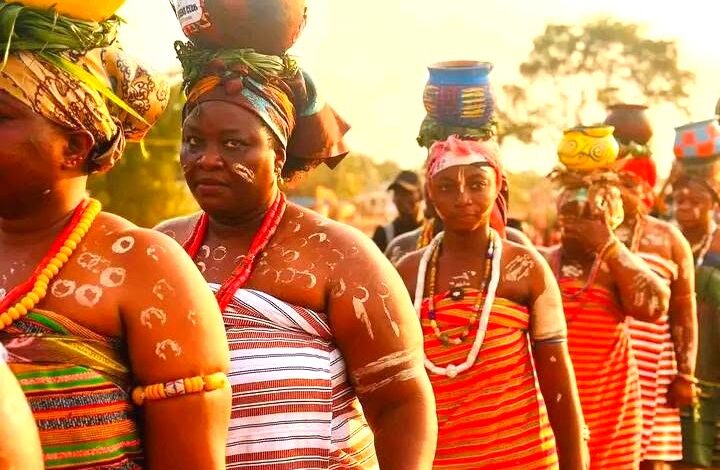
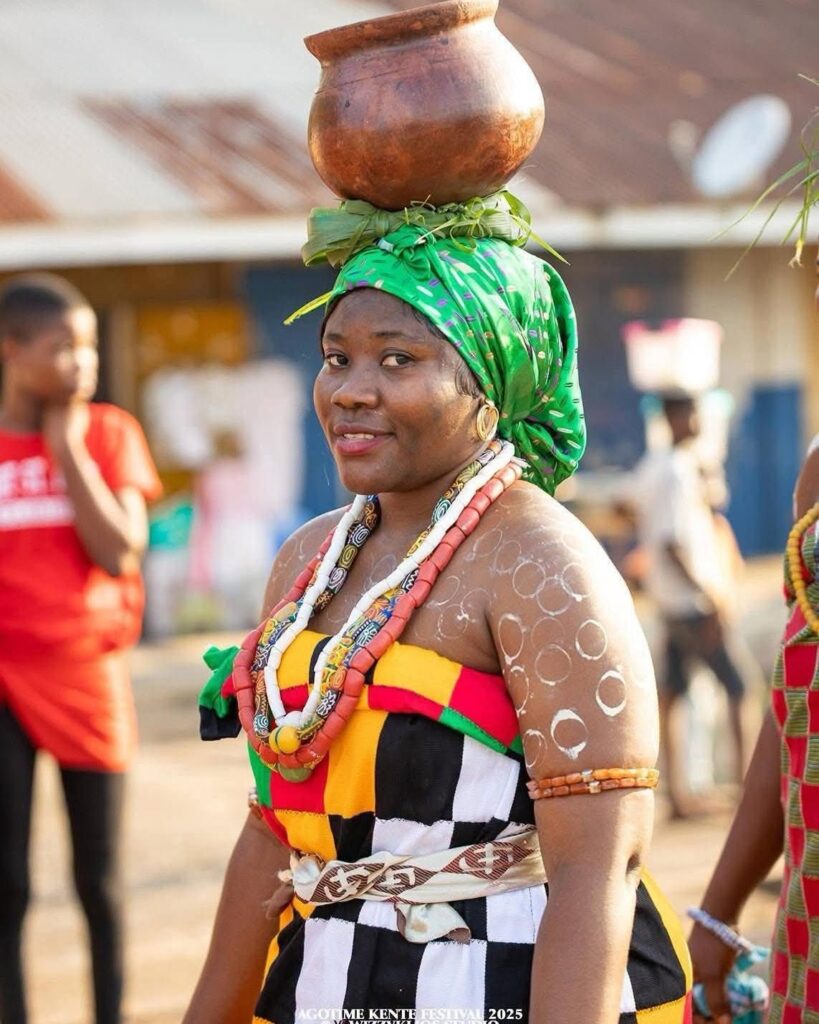
The return procession is particularly important. Participants have been documented walking back in a single file, dressed in beautiful Kente fabrics and carrying pots of water. The water is then poured into a traditional pot positioned at the forecourt of the paramount chief’s palace, where it is made available for visitors.
Music and dancing accompany the procession, transforming an everyday activity into a highly symbolic cultural performance.
This transformation of an ordinary household responsibility into a public cultural ceremony is one of the most fascinating aspects of Asialetorme.
One of the clearest meanings attached to Asialetorme is hospitality.
The Agotime Kente Festival attracts chiefs, queen mothers, community members, government officials, tourists, researchers and visitors from different parts of Ghana and beyond. During the festival, the community becomes a host to thousands of people.
Asialetorme symbolically expresses the community’s readiness to receive those guests.
The water brought by the women is therefore not merely water for drinking. It represents an offering of welcome, a traditional way of saying:
“You have come among us; we receive you.”
Graphic Online has described the rite as a demonstration of Agortime hospitality, noting that the water is brought back and poured into a traditional pot at the palace for visitors.
In this sense, Asialetorme converts hospitality from an abstract value into a visible public act.
Asialetorme also places women at the centre of cultural representation.
Traditional accounts of the ceremony describe participation by older women and maidens. The involvement of different generations is significant because it creates an intergenerational connection. Older women represent accumulated cultural knowledge, while younger women and maidens represent continuity and the future of the community.
The ceremony can therefore be understood as more than a festival performance. It is also a cultural classroom.
Through participation, younger generations encounter traditional expectations concerning:
respect for elders; communal service; hospitality; appropriate ceremonial conduct; dignity and presentation; the importance of water; women’s contribution to community life; and the preservation of inherited customs.
This is particularly important in an era when many indigenous practices are increasingly exposed to modernisation and changing lifestyles.
The journey to the riverside forms an important part of the symbolism of Asialetorme. Fetching water was historically an essential responsibility in many African communities. Before modern water systems, wells, streams, rivers and other natural sources were central to everyday life. Women and girls frequently played important roles in collecting and transporting household water.
Asialetorme preserves the cultural memory of that experience.
However, during the festival, the activity is no longer simply about obtaining water for domestic use. The journey becomes ceremonial. The participants move as a group, transforming a routine task into a collective expression of identity.
The movement from the water source back toward the festival grounds can therefore be interpreted as a symbolic movement from nature to community, and from daily life to ceremonial life.
Asialetorme is performed within the wider environment of the Agotime Kente Festival, also known as Agbamevor Za.
Agbamevor Za is an annual celebration centred on the cultural and economic importance of Kente among the Agotime people. Official district documentation identifies the festival as one of the major cultural attractions of the Agortime-Ziope area and notes the importance of Kente weaving as a household occupation within the Agotime Traditional Area.
The clothing worn during Asialetorme consequently adds another layer of meaning. The women return from the water source dressed in different Kente fabrics, creating a moving display of colour, pattern, artistry and cultural identity. Contemporary descriptions specifically emphasize the sight of the women returning in single file in Kente while carrying their water containers.
Thus, Asialetorme brings together two major elements of Agotime identity:
Water and Kente.
Water represents life, hospitality and communal service, while Kente represents artistry, identity, heritage and economic livelihood.
Together they create a powerful cultural tableau.
The Traditional Pot at the Palace
One of the most significant moments occurs when the women arrive at the palace. The water they have collected is poured into a traditional pot placed at the forecourt of the paramount chief’s palace. The water is then intended for the use of visitors.
The palace setting is important because the palace represents traditional authority and communal identity.
The procession therefore moves through several symbolic spaces:
Water source → community procession → palace → visitors.

Each stage connects to a different aspect of Agotime society. The water source represents nature and life. The women represent service and cultural continuity. The procession represents collective identity. The palace represents traditional authority. The visitors represent hospitality and the wider community gathered for the festival. Music, Dance and Celebration
Asialetorme is not performed as a silent household chore.
The return of the women is accompanied by music and dancing, creating an atmosphere of celebration.
This is characteristic of many African traditional ceremonies, where music, movement, clothing and communal participation transform cultural activities into memorable public experiences.
Music provides rhythm for the procession, while dancing communicates joy and collective pride.
The result is a ceremony that is simultaneously practical, symbolic and entertaining.
Perhaps one of the most important functions of Asialetorme is its role as cultural memory.
The ceremony keeps alive an older way of understanding community life. Modern water infrastructure may have reduced the necessity for many people to travel long distances to collect water, but the cultural memory attached to water collection has not disappeared.
Instead, Asialetorme places that memory within a festival environment.
The practice reminds younger generations that cultural heritage is not limited to monuments, palaces or historical stories. Heritage can also be found in ordinary activities ,fetching water, weaving cloth, preparing food, welcoming visitors and working together.
By transforming these activities into ritual and performance, communities preserve knowledge that might otherwise disappear.
The participation of older women and maidens gives Asialetorme an important intergenerational dimension.
Culture survives when knowledge moves from one generation to another.
An elder does not need to write a textbook to transmit cultural knowledge. She can demonstrate how a ceremony is performed, explain its meaning, teach younger participants the appropriate behaviour and allow them to participate directly.
Asialetorme provides precisely this kind of practical cultural education.
It is important to distinguish between what is documented about Asialetorme today and interpretations about its deeper historical origins.
Available contemporary sources clearly establish Asialetorme as an established component of the Agotime Kente Festival and identify it as a maiden’s water-fetching rite. Historical festival programmes from previous years also list the ceremony alongside Godigbe and other major cultural activities.
The modern Agotime Kente Festival has developed into a major cultural event featuring numerous activities, including Kente weaving competitions, Godigbe, Heroes and Heroines’ Day, Miss Kente, food bazaars, street carnivals and the grand durbar of chiefs and people. Asialetorme forms part of this wider cultural programme.
The festival brings together communities associated with Agotime in Ghana and Togo. Reports on the festival have referred to participation from 37 towns and villages across the two countries.
Consequently, Asialetorme should not be viewed in isolation. It belongs to a much broader cultural system in which migration history, traditional authority, Kente weaving, music, dance, food, women’s traditions and communal identity intersect.
In contemporary Ghana, traditional ceremonies face the challenge of remaining meaningful while adapting to modern society.
Asialetorme demonstrates one way cultural heritage can remain relevant.
It preserves a memory of traditional women’s work, It celebrates the importance of water. It showcases Kente. It promotes hospitality. It creates a role for younger generations. It brings visitors into contact with Agotime culture. And it strengthens the cultural identity of the community.
The rite also contributes to cultural tourism. The Agortime-Ziope District Assembly identifies the Agotime Kente Festival as an important tourism attraction and recognizes the area’s Kente industry as a significant part of the local economy.
For cultural tourists, Asialetorme offers something that cannot be captured adequately by simply purchasing a piece of Kente.
It provides an opportunity to witness the cultural environment in which the cloth, community and traditions exist. There is a danger in presenting traditional ceremonies only as colourful spectacles for tourists. The beauty of Asialetorme is certainly part of its attraction, but its cultural significance goes much deeper.
The Kente clothing, procession, water containers, music and dancing are the visible elements. Behind them are less visible values: service, dignity, womanhood, hospitality, community and continuity.
For the ceremony to survive meaningfully, these values must be explained to younger generations rather than allowing the rite to become merely a staged performance.
Agotime cultural custodians, historians, elders and festival organizers therefore have an important responsibility to document the oral traditions associated with Asialetorme, including its indigenous terminology, rules of participation, songs, route, water source, symbolism and historical evolution.
Such documentation would provide future generations with a stronger record of the tradition. Asialetorme teaches an important lesson about African heritage. Sometimes the most profound cultural meanings are hidden inside ordinary activities.
Fetching water is ordinary.
But when a community transforms that act into a ceremonial procession, dresses the participants in Kente, accompanies them with music and dance, welcomes them at the traditional palace and uses the water to serve visitors, the ordinary becomes extraordinary.
Credit:- Heritage Trials Africa