
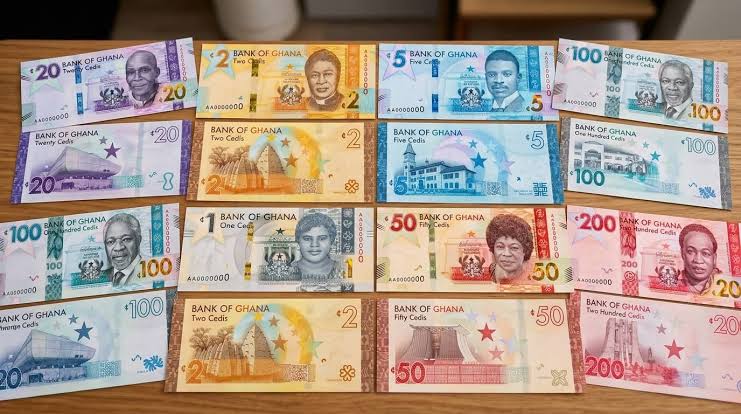
The introduction of Ghana’s new Cedi Heritage Series has brought renewed attention to eight prominent Ghanaians whose contributions to the country’s history are being recognised through the national currency.
From a market woman who helped mobilise financial and political support for the independence struggle to a diplomat who led the United Nations, the personalities featured on the new banknotes represent different chapters of Ghana’s development.
They include traders, religious leaders, educationists, a judge, a composer, an artist, an international diplomat and the country’s first President.
President John Dramani Mahama officially launched the redesigned banknotes on Thursday, November 12, 2026, at the Bank of Ghana headquarters in Accra.
The new notes, which retain the existing denominations of GH¢1, GH¢2, GH¢5, GH¢10, GH¢20, GH¢50, GH¢100 and GH¢200, will enter circulation on December 1, 2026.
Unlike the previous designs, which featured a collective portrait of the Big Six on the GH¢2 note, the Heritage Series gives individual recognition to eight personalities whose work and influence have helped shape the country.
While some of them are household names, others are less familiar to younger generations, despite their important contributions to Ghana’s political, economic, educational and cultural development.
Here is a closer look at their lives and the legacies they leave behind.
GH¢1 – Agnes Oforiwa Tagoe-Quarcoopome: The market woman who helped finance Ghana’s independence struggle.
BuyMaps

One of the most interesting personalities featured on the new banknotes is Agnes Oforiwa Tagoe-Quarcoopome, popularly known as Auntie Oforiwa.
Unlike the politicians and prominent national figures often associated with Ghana’s independence struggle, Tagoe-Quarcoopome made her contribution through business, organisation and the mobilisation of market women.
Born on May 27, 1913, she became a successful trader in Accra, operating businesses in Makola and Okaishie, two of the city’s major commercial centres.
She reportedly began her trading activities at a young age after circumstances prevented her from continuing her education.
Through hard work and business acumen, she gradually established herself as one of the respected women traders of her time.
By the 1940s, she had become a prominent figure among Accra’s market women. She is particularly remembered for becoming the first Makola market woman to open a bank account with the then Standard Bank of West Africa, now Standard Chartered Bank Ghana.
BuyMaps
At a time when many traders preferred to keep their savings at home, her decision to use formal banking services was considered an important step. Her example reportedly encouraged other market women and businesspeople to develop confidence in the banking system.
However, her contribution went beyond commerce.
Tagoe-Quarcoopome was a supporter of Dr Kwame Nkrumah and the Convention People’s Party (CPP), which led the campaign for independence.
She helped mobilise market women to support Nkrumah’s political activities, organise meetings and raise funds for the independence campaign.
TrackExec Orders
Market women were an important part of the independence movement, providing financial resources, political support and a strong grassroots network.
Her role illustrates how women outside formal political institutions contributed to the struggle that eventually led to Ghana’s independence on March 6, 1957.
Her inclusion on the GH¢1 note is therefore significant because it recognises the contribution of traders and ordinary working women to the country’s economic and political history.
TradeForex
It also brings attention to a group whose role in Ghana’s independence story has often received less recognition than that of prominent political leaders.
GH¢2 – Cardinal Peter Poreku Dery: The religious leader who rose from a small community to the College of Cardinals.

The GH¢2 note honours Cardinal Peter Poreku Dery, one of Ghana’s most distinguished Catholic religious leaders and the country’s first cardinal.
TradeForex
He was born on May 10, 1918, at Zemuopare (Ko), near Nandom in what is now the Upper West Region.
Dery’s journey into religious leadership was significant, particularly considering the limited educational and institutional opportunities available in many communities in northern Ghana at the time.
He was ordained a Catholic priest on February 11, 1951, becoming the first indigenous priest from the Upper West Region.
His service to the Church took him through several responsibilities, including parish ministry, educational administration and diocesan leadership.
A major turning point came in 1960 when he was appointed the first Bishop of Wa following the establishment of the Diocese of Wa.
During his time as bishop, he placed considerable emphasis on education and the development of the Catholic Church in northern Ghana.
He founded several schools and a minor seminary, helping to strengthen the Church’s educational and religious institutions.
He also encouraged the incorporation of local cultural expressions into Catholic worship, an approach known as liturgical inculturation. This helped make religious practices more responsive to the cultural experiences of the communities they served.
In 1974, he was appointed Bishop of Tamale. Three years later, when Tamale was elevated to an archdiocese, he became its first Archbishop.
His influence extended beyond Ghana. He served as president of the Ghana Catholic Bishops’ Conference and held positions within the wider Catholic Church.
BuyMaps
On March 24, 2006, Pope Benedict XVI elevated him to the College of Cardinals, making him the first Ghanaian to receive that distinction.
The appointment was a major milestone for the Catholic Church in Ghana and brought international recognition to the country’s religious leadership.
Cardinal Dery died on March 6, 2008, at the age of 89.
His appearance on the GH¢2 note recognises his contribution to religious development, education and the growth of the Catholic Church, particularly in northern Ghana.
GH¢5 – Dr James Emman Kwegyir Aggrey: The educationist who believed education could transform Africa.

The GH¢5 note features Dr. James Emman Kwegyir Aggrey, a Ghanaian educationist, minister and intellectual whose ideas about education and human development extended beyond the Gold Coast.
TradeForex
Born on October 18, 1875, at Anomabu in the Central Region, Aggrey grew up at a time when access to formal education for Africans was limited.
He received his early education through Wesleyan Methodist schools and later became a teacher and preacher.
His abilities earned him an opportunity to travel to the United States in 1898 to pursue further education at Livingstone College in North Carolina.
He graduated with a Bachelor of Arts degree in 1902 and subsequently obtained further qualifications, including a Master of Arts and a Doctor of Divinity degree in 1912.
He remained at Livingstone College as a lecturer and professor for several years, combining his academic work with religious ministry.
Aggrey also became involved in wider discussions about education in Africa.
In 1920, he joined the Phelps-Stokes Commission on African education, which examined educational conditions across different parts of the continent.
As the only African member of the commission, he played an important role in interpreting African educational needs and experiences to audiences in Europe and America.
His work took him to several African countries, where he advocated an education system that would develop the intellectual, practical and social abilities of Africans.
He believed education should not simply produce people who could read and write but should equip them to contribute meaningfully to their communities and society.
Enrollin Classes
Aggrey was also a strong advocate for racial cooperation and equality.
He is widely associated with the illustration of a piano keyboard, using its black and white keys to explain that both races were necessary to produce harmony.
The message was that neither black nor white people should be considered inferior, as society needed the contributions of all.
In 1924, he returned to the Gold Coast and joined the newly established Achimota College as assistant vice-principal under its first principal, Alec Garden Fraser.
He became an important figure in the development of the institution, helping to connect the school with African society and encouraging an educational approach that recognised African culture and identity.
Unfortunately, his life was cut short. He died in New York in July 1927, aged 51, while seeking to complete his doctoral studies.
Although his time in Ghana after returning from the United States was relatively short, his influence on education and debates about Africa’s intellectual development remains significant.
His appearance on the GH¢5 note recognises the importance of education as a foundation for national development and celebrates a Ghanaian whose ideas reached far beyond his lifetime.
GH¢10 – Justice Annie Jiagge: The Ghanaian woman who made history in the judiciary and championed women’s rights
BuyMaps

Justice Annie Ruth Jiagge is one of the most remarkable women in Ghana’s legal history.
She was a pioneering lawyer and judge whose achievements opened doors for women in the judiciary while placing Ghana at the centre of international discussions on women’s rights.
Born Annie Ruth Baëta on October 7, 1918, in Lomé, then part of French Togoland, she received her early education in the Gold Coast.
She initially pursued a career in teaching and became a headmistress of the Evangelical Presbyterian Girls’ School.
However, she later decided to study law, a profession that was largely dominated by men at the time.
With financial support from her mother, she travelled to Britain in 1946 to study at the London School of Economics.
She obtained her law degree in 1949 and was called to the Bar at Lincoln’s Inn in 1950.
After returning to the Gold Coast, she began practising law before moving into the judiciary.
Her rise through the judicial system was historic.
She became a magistrate in the 1950s, a Circuit Court judge in 1959 and a High Court judge in 1961, making her the first Ghanaian woman to hold that position.
In 1969, she was elevated to the Court of Appeal and later became its president in 1980, a position she held until her retirement in 1983.
At a time when women faced considerable barriers in professional and public life, Jiagge demonstrated that women could occupy the highest positions in the legal system.
But her contribution was not limited to Ghana’s courts. She became a leading voice in the international campaign for women’s rights through her work with the United Nations Commission on the Status of Women.
Ghana appointed her to the commission in the early 1960s. She later served as its rapporteur and became its president in 1968.
BuyMaps
One of her most important contributions was her involvement in preparing the Declaration on the Elimination of Discrimination against Women, which was adopted by the United Nations General Assembly in 1967.
The declaration became an important foundation for subsequent international efforts to eliminate discrimination against women, including the Convention on the Elimination of All Forms of Discrimination against Women adopted in 1979.
Jiagge also contributed to women’s development in Ghana.
She chaired the National Council on Women and Development, established in 1975, which worked to advance women’s participation in national development and address issues affecting women across the country.
Her work helped move women’s rights beyond discussions and towards policies and institutions that could address inequality.
She also held important positions in international religious and development organisations, including the World Council of Churches.
Justice Jiagge died on June 12, 1996, but her contribution to the judiciary and the global struggle for gender equality remains part of Ghana’s history.
Her appearance on the GH¢10 note is a recognition of a woman whose work helped challenge discrimination and expand opportunities for women in Ghana and internationally.
GH¢20 – Dr Ephraim Amu: The composer who gave Ghana one of its most cherished patriotic songs.

For many Ghanaians, the name Dr Ephraim Amu is closely associated with one of the country’s most familiar patriotic songs, ‘Yɛn Ara Asaase Ni’.
The celebrated composer, musicologist, teacher and cultural advocate is the personality featured on the GH¢20 note.
Born on September 13, 1899, at Peki Avetile in the Volta Region, Amu developed an interest in education and music from an early age.
He completed his middle school education at Peki Blengo in 1915 before enrolling at the Basel Mission Seminary at Abetifi in 1916 to train as a teacher and catechist.
His professional career took him into teaching, where he began developing his ideas about the importance of African music and cultural identity.
At a time when European musical traditions strongly influenced formal music education and church worship, Amu argued that African musical traditions deserved recognition and respect.
He encouraged the use of indigenous instruments, rhythms, languages and musical expressions in compositions and Christian worship.
His work was not simply about entertainment. He saw music as an important way of expressing African identity, values, patriotism and social responsibility.
Amu composed more than 200 musical works in languages including Ewe, Twi and Ga, alongside some English compositions.
Among his best-known works are ‘Yɛn Ara Asaase Ni’, meaning ‘This is our own land’, ‘Abibirima’ and other choral compositions that celebrate African identity and encourage national consciousness.
‘Yɛn Ara Asaase Ni’ remains one of Ghana’s most cherished patriotic songs and is performed at national and ceremonial occasions.
Although it is not Ghana’s official national anthem, its message of love for the country has made it an enduring part of the nation’s musical heritage.
Beyond composing, Amu was an influential teacher and music educator.
He taught at institutions including the Presbyterian Training College at Akropong and Achimota College, where he helped develop an approach to music education that recognised African musical traditions.
He also contributed to the development of music scholarship and the study of African music.
His work helped establish a foundation for later generations of Ghanaian composers, musicians and music researchers.
Amu’s contribution received national recognition, including the Order of the Volta.
He died in 1995 at the age of 95. His appearance on the GH¢20 note celebrates a man who used music to promote cultural pride and remind Ghanaians of the importance of preserving their identity.
GH¢50 – Theodosia Salome Okoh: The artist who designed Ghana’s national flag.

Every time Ghanaians see the red, gold and green flag with the black star, they are looking at the work of Theodosia Salome Okoh, the woman featured on the GH¢50 note.
Okoh was a Ghanaian artist, teacher and sports administrator whose contribution to national identity remains visible more than six decades after independence.
Born on June 13, 1922, at Effiduase in the Ashanti Region, she was one of the children of Reverend Emmanuel Victor Asihene and Dora Asihene.
She received her early education in Ghana and later trained as a teacher before pursuing further studies in art at Achimota School.
Her artistic training helped develop the skills that would eventually make her one of the most recognised figures in Ghana’s national history.
In 1957, as the Gold Coast prepared to become an independent country, a new national flag was required to represent the emerging nation.
Okoh designed the flag that was adopted at independence on March 6, 1957.
The flag’s colours carry important national symbolism. The red represents the blood of those who died in the struggle for independence, gold represents the country’s mineral wealth, and green represents its forests and natural resources.
The black star represents African freedom and unity. Her design became one of the most powerful symbols of Ghana’s sovereignty and identity, appearing at government institutions, schools, sporting events and international gatherings.
But Okoh’s contribution to Ghana extended beyond the design of the national flag. She was also an important figure in the development of hockey in the country.
She served as chairperson of the Ghana Hockey Association and played a major role in promoting the sport and developing facilities.
She was involved in the establishment of the national hockey pitch in 1964 and became the first woman to head the country’s national sports association.
Her leadership helped strengthen Ghana’s participation in international hockey, with the country eventually qualifying for major international competitions, including the Olympic Games.
She also supported youth development and community initiatives through her involvement in organisations such as the Junior Red Cross and the Young Women’s Christian Association.
For her contributions to art, sports and national development, she received several honours, including the Grand Medal.
Okoh died on April 19, 2015, at the age of 92.
Her appearance on the GH¢50 note is particularly significant because the national flag she designed continues to represent Ghana wherever it is displayed.
It is a reminder that national identity is not shaped only by politicians and public officials but also by artists and creative minds whose work becomes part of a country’s history.
GH¢100 – Kofi Annan: The Ghanaian diplomat who led the United Nations.

Kofi Atta Annan was one of Ghana’s most influential figures on the international stage.
The diplomat, who became the seventh Secretary-General of the United Nations, is featured on the GH¢100 note in recognition of his contribution to international peace, diplomacy and cooperation.
Born on April 8, 1938, in Kumasi, Annan pursued his early education in Ghana before travelling abroad for further studies.
He studied economics at Macalester College in the United States and later obtained a Master of Science degree in Management from the Massachusetts Institute of Technology.
His career with the United Nations began in 1962 when he joined the World Health Organization in Geneva as an administrative and budget officer.
Over the years, he served in different capacities across the UN system, gaining experience in administration, peacekeeping, humanitarian affairs and international relations.
His career included assignments with the United Nations Economic Commission for Africa in Addis Ababa, the UN High Commissioner for Refugees and several departments at the UN headquarters in New York.
Before becoming Secretary-General, he served as the UN Under-Secretary-General for Peacekeeping Operations.
In January 1997, Annan became the seventh Secretary-General of the United Nations, making history as the first person from sub-Saharan Africa to hold the position.
He served two terms, from 1997 to 2006.
During his tenure, he championed reforms aimed at making the United Nations more effective and responsive to global challenges.
He placed particular emphasis on human rights, poverty reduction, development, peacekeeping and the promotion of international cooperation.
He also supported the establishment of the Millennium Development Goals, which provided a global framework for addressing poverty, hunger, disease, gender inequality and other development challenges.
Annan played an important role in strengthening UN peacekeeping operations and promoting the responsibility of the international community to protect civilians during conflicts.
In 2001, he and the United Nations jointly received the Nobel Peace Prize for their work towards a better-organised and more peaceful world.
His international influence also extended to conflict resolution. In 2006, he helped mediate the settlement of a longstanding territorial dispute between Cameroon and Nigeria over the Bakassi Peninsula.
After leaving office in 2006, Annan continued to work on peace and development issues.
He established the Kofi Annan Foundation, which promotes peace, democratic governance, sustainable development and human rights.
He also served as a prominent international mediator and was involved in efforts to address political crises in different parts of the world.
Annan died on August 18, 2018, in Switzerland at the age of 80.
His appearance on the GH¢100 note recognises a Ghanaian whose influence reached the highest levels of international diplomacy and whose work placed Ghana prominently on the global stage.
GH¢200 – Dr Kwame Nkrumah: The man who led Ghana to independence.

The highest denomination in the new Cedi Heritage Series, the GH¢200 note, features Dr Kwame Nkrumah, Ghana’s first President and the central figure in the country’s struggle for independence.
Born on September 21, 1909, at Nkroful in the Western Region, Nkrumah trained as a teacher before travelling to the United States in 1935 to pursue further studies.
He attended Lincoln University in Pennsylvania, where he obtained degrees in theology and philosophy, and later pursued graduate studies at the University of Pennsylvania.
He also travelled to Britain, where he became involved in the Pan-African movement and worked with other African and Caribbean activists who advocated an end to colonial rule.
His political journey took a major turn in 1947 when he returned to the Gold Coast to serve as general secretary of the United Gold Coast Convention (UGCC), a political movement seeking constitutional reforms and self-government.
However, disagreements over the pace and approach to achieving independence led him to break away from the UGCC in 1949 to establish the Convention People’s Party.
Under the CPP, Nkrumah adopted the ‘Positive Action’ campaign, which used strikes, boycotts and other forms of political mobilisation to demand self-government.
The campaign led to his arrest and imprisonment in 1950 by the colonial authorities.
However, the CPP won the 1951 general election, and Nkrumah was released from prison to lead the new government as Leader of Government Business.
He subsequently became Prime Minister and led the country to independence on March 6, 1957, when the Gold Coast became Ghana.
Nkrumah later became Ghana’s first President when the country became a republic in 1960.
His government pursued an ambitious development agenda, investing in education, healthcare, roads, industries and major infrastructure projects.
Among the most significant projects associated with his administration was the Volta River Project, which led to the construction of the Akosombo Dam and the development of electricity generation to support industrialisation.
He also championed the expansion of education and the establishment of institutions intended to develop Ghana’s human capital and technical capacity.
Beyond Ghana, Nkrumah became one of Africa’s leading advocates for continental unity.
He believed that political independence would remain incomplete without economic cooperation and unity among African countries.
In 1963, he played a major role in the establishment of the Organisation of African Unity, the predecessor of the African Union.
His vision of a united Africa made him an influential figure in the Pan-African movement and the wider struggle against colonialism.
However, his presidency was also controversial.
His administration became increasingly authoritarian, particularly after Ghana became a one-party state in 1964. Restrictions on political opposition and the detention of opponents attracted criticism.
On February 24, 1966, while he was on a state visit to Vietnam, his government was overthrown in a military coup.
He spent his final years in exile, mainly in Guinea, where he was named honorary co-president, before dying in Bucharest, Romania, on April 27, 1972.
Despite the controversies surrounding his rule, Nkrumah remains a central figure in Ghana’s independence history and one of the most influential advocates of African liberation.
His appearance on the GH¢200 note recognises his role in securing Ghana’s independence and shaping the country’s early political and development agenda.
A currency that tells the story of a nation
The eight personalities featured on Ghana’s new Cedi Heritage Series represent different areas of national life.
From Agnes Oforiwa Tagoe-Quarcoopome’s contribution to commerce and the independence struggle to Cardinal Peter Poreku Dery’s religious leadership, James Aggrey’s educational ideas, Annie Jiagge’s legal achievements and Ephraim Amu’s musical legacy, the banknotes tell a story that goes beyond money.
Theodosia Okoh’s national flag design, Kofi Annan’s international diplomacy and Kwame Nkrumah’s leadership in the independence movement further reflect the different ways individuals have shaped Ghana’s identity.
Their stories also offer an opportunity for younger generations to learn about people whose contributions may not always receive sufficient attention in everyday discussions about the country’s history.
As the new banknotes enter circulation, Ghanaians will have an opportunity to become more familiar with the people whose faces appear on the currency.
Ultimately, the Heritage Series is not only a redesigned set of banknotes. It is also a reminder of the people, ideas and struggles that have helped shape the Ghana we know today.
Source:- theghanareport.com