Cabinet has directed the Finance and Energy Ministers to cut fuel prices and roll out mass transport interventions to cushion Ghanaians against rising global oil prices triggered by escalating Middle East tensions.
The directive includes the removal of selected taxes and margins on petroleum products, effective the next pricing window, expected within a week.
In a parallel intervention, the Cabinet has instructed the Minister of Transport to immediately deploy 100 newly acquired Metro Mass Transit buses to ease commuting pressures and stabilise transport fares.
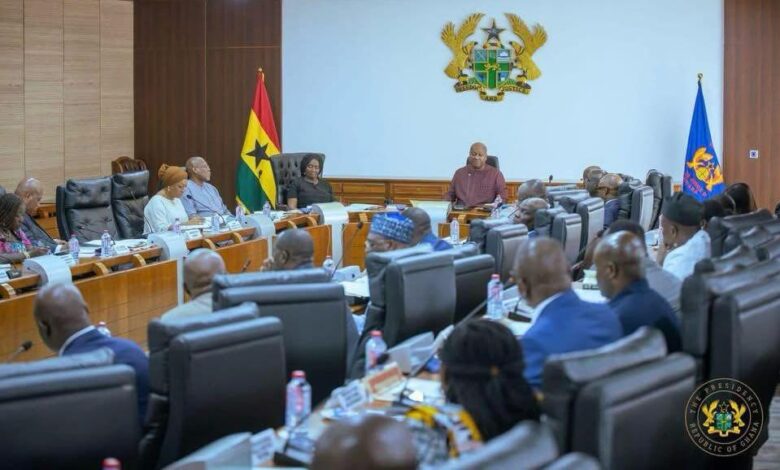
Mr Felix Kwakye Ofosu, Presidential Spokesman and Minister of State in-charge of Government Communications, announced this at a press conference at the Presidency in Accra on Thursday.
He said the decisions were taken at an emergency Cabinet meeting chaired by President John Dramani Mahama to assess the impact of the United States-Israel-Iran conflict on Ghana’s economy.
Mr Ofosu said the escalation had led to significant increases in global crude oil and refined petroleum prices, with direct consequences for fuel prices at the pump.
“So the Cabinet convened a session to review these developments, assess their impact on the people of Ghana, and consider ways through which this can be mitigated,” he said.
He noted that recent macroeconomic gains, including the appreciation and relative stability of the Ghana cedi and a decline in inflation to about 3.2 per cent, had helped cushion the impact of the external shocks.
He explained that fuel prices remained comparatively lower than levels recorded during the 2022 Ukraine conflict, despite current global pressures.
Mr Ofosu, however, said increases recorded over the last two pricing windows risked triggering higher transport fares and general price hikes, with implications for the cost of living.
He attributed the increases largely to disruptions in the Strait of Hormuz, a critical global oil transit route through which about 20 per cent of crude shipments pass.
The restrictions, he said, had resulted in higher insurance premiums and transportation costs, pushing up fuel prices despite Ghana’s relatively stable economic environment.
Mr Ofosu said the Cabinet had, therefore, resolved to act swiftly to prevent further escalation through targeted fiscal and transport interventions.
Mr Ofosu stated that the tax and margin adjustments would remain in force for an initial four-week period, after which the situation would be reviewed.
He said further measures would be taken as necessary, depending on prevailing conditions.
An additional 100 Metro Mass buses were expected in August, with a final batch of 100 due in November, bringing the total fleet to 300.
The buses would be deployed along high-traffic corridors to reduce commuter burden and offer fares lower than those charged by private operators, particularly during peak periods.
“The Transport Minister has also been charged with ensuring that these Metro Mass buses, in addition to the existing ones, charge or maintain transport fares which are lower than what private sector operators charge,” he said.
“And this is to ensure that the needs are cushioned, especially when we reach peak periods at the rush hour.”
Mr Ofosu also noted that the President had reminded Ministers and senior government officials to strictly comply with the ban on fuel allowances and allocations.
He said the directive applied to all government appointees without exception.
The current conflict involving the United States, Israel and Iran escalated into active hostilities on February 28, 2026, raising tensions across the Middle East and threatening global oil supply routes, particularly through the Strait of Hormuz.
Although a two-week ceasefire is currently in force, with diplomatic efforts underway, the conflict has already triggered volatility in global energy markets, driving up crude oil prices, increasing shipping and insurance costs, and exerting inflationary pressures on economies worldwide, especially import-dependent countries.
Source:- GNA